
The Six Irrigation Water Questions HCT Gets Asked Most, and How We Answer Them
Updated: 3 days ago
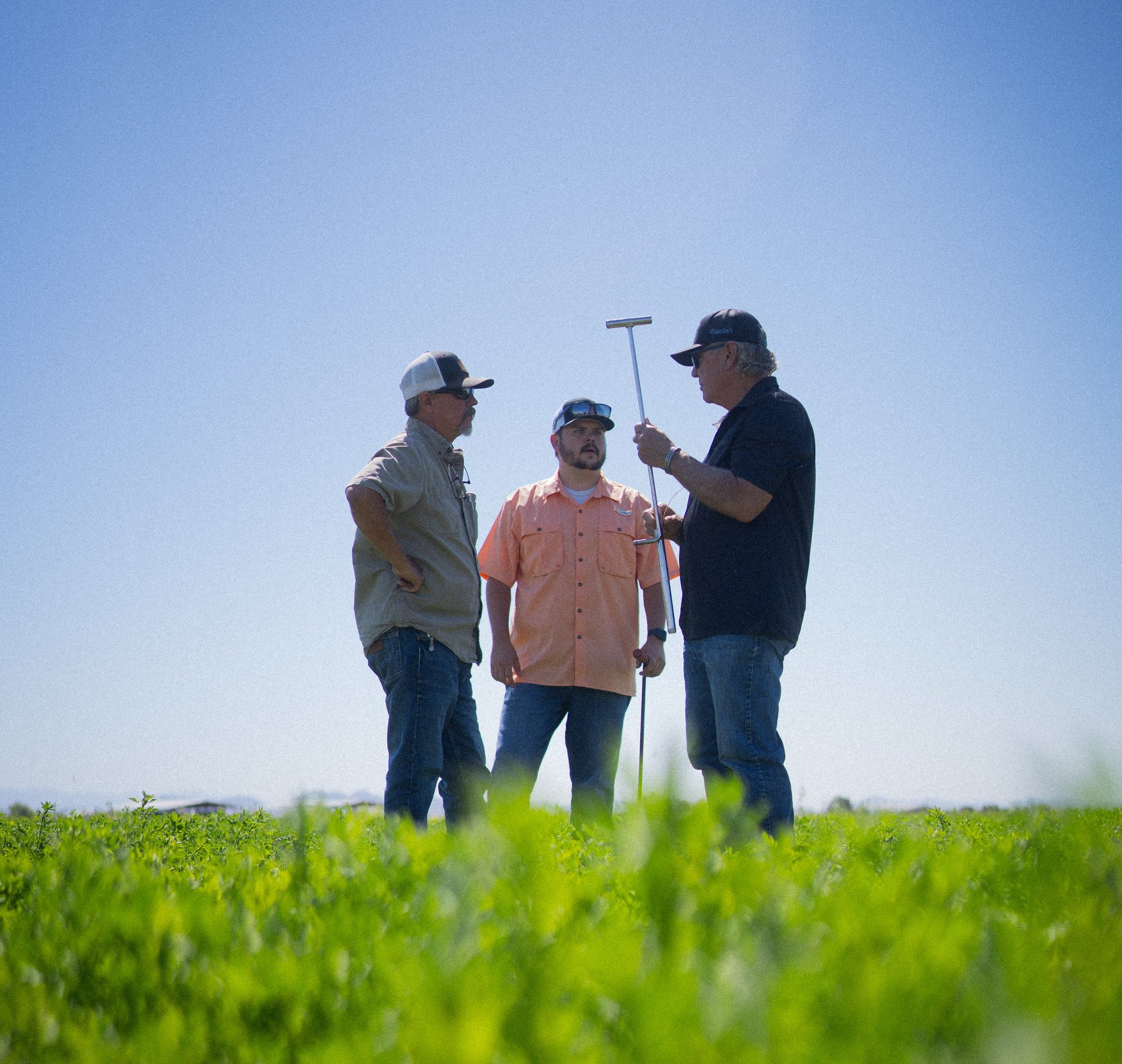
Most of our week at HCT is spent on the phone and in email with superintendents, growers, well contractors and the dealers who serve them. We went back through two years of those conversations, from first inquiries to lab reports to mid-season troubleshooting, looking for the irrigation water and soil questions that come up over and over.
There are six. They arrive from golf courses in the Carolinas, orchards in California and municipal wells in Arizona. The wording changes. The questions don't, and neither do our answers.
So here they are, the way we give them. Many of the answers below are in the words of our CEO, Todd Eden, taken directly from those replies. Names and sites are left out. The answers are not softened.
1. "My irrigation water test came back fine. So why is the turf struggling?"
Our first move is always the same: read the irrigation water data, then ask about the one thing a standard water test almost never includes.
Would you swim in the water you use to water your vegetation? Probably not, because the water is usually somewhat septic. Septic means bacteria. — Todd Eden, HCT
Bacteria move from the water into the soil. Given food sources like sulfur, sulfate, iron and manganese, and soil without enough pore space, colonies establish and, as Todd puts it, "can populate exponentially as often as every 15 minutes." What follows are the slimes and exudates behind slosh areas, collection areas that never dry, foul odors and infiltration that keeps getting worse, none of which show up as a number on a mineral panel.
So when a director of agronomy sends over a clean-looking analysis, our reply is usually a compliment followed by a caveat. To one recently: "This is really great water, with a little help that we can provide." Then a request for a bacteria count before anything else is decided.
2. "The soil report says I'm low on calcium. Should I add some?"
This is the question we most want to reframe, because the answer depends entirely on how the number was produced.
Most "available" or "soluble" results come from soaking your soil in lab water at a one-to-one ratio for twelve to twenty-four hours. "Exchangeable" results use a blend of acids and acetates meant to imitate what a root exudes. Our view of the second column is blunt.
I'd simply take a black marker and cover the numbers. — Todd Eden, HCT
The reason is that the method caps out. "You could have 3,500 ppm exchangeable calcium, add 1,000 ppm calcium, and it would still report 3,500 ppm. When in actuality, you could do a total digestion and find you have 10,000 ppm calcium. That's 20,000 pounds per acre, at which point you might call the soil cement or plaster, versus soil."
That is why our Legacy Analytical method runs a total soil digestion, using nitric acid and hydrogen peroxide to break the soil down completely and report what is actually there, and then soaks your soil in your own irrigation water, four parts water to one part soil, for 72 hours, to see what the plant can actually drink.
The practical answer to the calcium question, then, is usually no. "The need for and amounts of fertilizers are identified from the soil's total soil digestion testing, not from the saturated-paste test deficiencies." In most soils we see, "the soil has plenty of nutrients we can harvest," and the job is to make what is already there available rather than to buy more of it.
3. "Should I just push more water through to flush the salts?"
No. This one comes up in nearly every troubleshooting thread, and our answer never changes.
Be sure to maintain soil moisture and water to water. Do not water to flush. — Todd Eden, HCT, to a turf dealer
The instruction that follows is the part people miss: "You'll usually have to adjust your ET factor, reduce it, to maintain the soil moisture, not replenish the normal ET-estimated water loss." Once treated water starts opening the profile, the old irrigation schedule over-waters.
And when infiltration slips, the fix is chemistry, not volume. "If you lose infiltration rate and depth, let's adjust the appropriate chemical rates, not increase water and flushing." For stubborn spots there is a mechanical note too: "Ninja-tine problem areas. It will allow for more of the treated water into those soils."

4. "Can I put my micronutrients in with your product?"
Yes for Curative, with arithmetic. Never for BC.
When a distributor's agronomist asked about copper and zinc, the answer came with the math attached. "Cu, Zn and concentrate go into the Curative. The numbers noted are per 55-gallon drum of the Curative. Divide the amount to add by 55, then multiply by the number of gallons in the drum."
NOTHING is ever added into the BC. It will react violently to just about anything added. — Todd Eden, HCT
The reason micronutrients end up in the water at all is a pattern we flag often: the source water is deficient in zinc and copper, and while they are present in the soil, they are not available to the plant from the soil. So calculated amounts go into the Curative and arrive with the water.
5. "What is the treatment actually doing?"
Asked directly, we answer in three sentences. Here they are as Todd wrote them to a prospective client.
We are sequestering the soluble salts of the water so the elements stay ionic. Even when evaporated to dryness, they re-hydrate. This is done linear to water quality. — Todd Eden, HCT
That is the whole difference between hard water that feeds and hard water that cements. Minerals that stay in an ionic, re-dissolvable form go back into solution with the next irrigation instead of drying into scale in the lines and crust in the soil.
We are treating the bacteria at the host level, assuring the bacteria in the soil stay gram-positive. This also degrades to dissolved oxygen and healthy water. — Todd Eden, HCT
The third part is what we manage the data against: total soil nutrition alongside actual available nutrition, plus the biology. "We do subscribe to the MLSN. But we also subscribe to the biology, mostly indicative to bacteria, aerobic, anaerobic, their waste products and gram-positive bacteria." The outcomes we point people to are not pH readings. They are infiltration rate, infiltration depth, and whether the vegetation is visibly stronger.
6. "This report is a lot. Where do I even start?"
A Legacy Analytical report is dense, and we know it. Our reply to a dealer who had just forwarded one to a nervous client:
I know this is heavy. Let's get on together with your client and go over it. Most of our dealers come to love it, live by it, and it not only works but builds a lot of referrals from what it delivers for the client. — Todd Eden, HCT

The standing offer is a thirty to forty-five minute online session to "walk you through your water analysis, the difference in the soil testing methods, the data, trackability, accountability, benefits and value of the program, as well as cost, and the magnitude of savings."
Before that call, the question is what to test. Our answer is tiers. "Existing root zone, desired root zone, and within desired, a confining layer if it exists. Greens might be a set of three tiers. Fairways another set." Good areas and bad areas both, because the comparison is the diagnosis.
Wells follow the same rule. "It all starts with data acquisition of well dynamics, history and groundwater quality," before any chemistry is chosen.
What runs through all six
We rarely use the word product. When a new prospect thanks us for information on "products and services," our reply gently corrects it: "more accurately described as a program." Every one of the six answers above comes back to the same order of operations: test the irrigation water including its bacteria, test the soil by total digestion, set the chemistry from the data, water to the root zone, then re-test and adjust. The product is the third step, not the first.
If you want the short version to keep by the phone:
A clean mineral panel is not a clean water test. Count the bacteria.
Cover the exchangeable column. Total digestion tells you what is really in the soil.
Water to water, never to flush. Lower the ET factor as the soil opens up.
Micronutrients go in the Curative, by the drum math. Nothing ever goes in the BC.
The chemistry keeps salts ionic and the soil aerobic. Judge it by infiltration, not pH.
When the report feels heavy, book the walkthrough. Test in tiers, good areas and bad.
Have a water or soil report you'd like walked through? Order Legacy Analytical Testing, or send your existing results to an authorized HCT dealer and ask for the thirty-minute session. It is the same one we offer everyone.
Quotations are from HCT correspondence and are lightly edited for length. Results vary by site, water quality and management practices.




Comments